

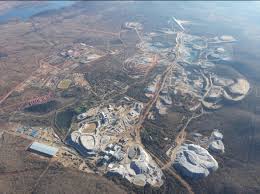
THE recent report by the United States House Select Committee on Chinese investment in Africa and the wider Global South—titled “China’s Minerals Mafia”—is less an audit of mining practices and more a window into American anxieties about a shifting global order.
The report comes at a time when control over critical minerals, particularly lithium, has become central to industrial power, energy transition, and geopolitical leverage.
In that context, what the US says about China and access to strategic minerals should be read within the framework of a declining power trying—and failing—to stave off the rise of a new power.
What needs to be appreciated, as a starting point to understanding why the US House Select Committee has issued the report that it has, is that China’s dominance is not incidental: it is structural.
From extraction to processing to manufacturing, Beijing has built an ecosystem that Washington has failed to replicate in the China-US strategic competition over critical minerals—the lifeblood of modern industry, new energy, and national defense.
China leads the world in mining, smelting, processing, and manufacturing capacity: over 94 percent of rare-earth refining, 70 percent plus of lithium processing, and 86 percent of global critical mineral refining. The US relies on China for 30 out of 50 critical minerals, with 12 minerals fully dependent and 29 with dependence above 50 percent.
Against that backdrop, the US report reads as weaponised communication. It is an attempt to recast Chinese industrial success as criminality, and African partnership of China as victimhood—while totally ignoring America’s own shortcomings as a power on the wane.
Washington’s hard decoupling policies have stalled. Its “de-Chinaification” drive cannot bypass China’s technology, scale, and cost advantages. This report is Washington’s shift to soft warfare: a propaganda offensive to legitimise containment, mobilise allies, and reverse its strategic disadvantage.
And it is quite ironic that the US, which has for decades treated the rest of the world as a source of cheap raw materials, suddenly pretends to be quite keen to “protect” Africa from Chinese friendship.
In African capitals like Harare, the view is markedly different from what the US House Select Committee sees. For Zimbabwe, mining contributes over 80 percent of export earnings and about 12 percent of GDP. As such, mining-related decision-making is not something taken lightly.
For over a century, Western capital dominated extraction with extremely low local beneficiation, limited job creation, and widespread environmental harm.
Since 2018, Chinese investment has transformed the sector: Zimbabwe became Africa’s largest lithium producer, reaching 10 percent of global hard-rock lithium output by 2025.
This is not looting. It is resource sovereignty in action.
For Zimbabwe, lithium is not an abstract geopolitical asset; it is a cornerstone of economic transformation.
This changes, and growth, being witnessed are not accidental. They reflect deliberate policy underpinned by progressive resource nationalism, beneficiation and industrialisation.
To characterise Chinese involvement in this transformative process as resource “looting” with assistance from corrupt local leaders is to ignore history, African agency and the contemporary reality of a continent that is increasingly leery of Western neo-liberal models that have failed to deliver development after colonialism.
For over a century, Western capital dominated African extraction under conditions that prioritised raw exports, suppressed value addition and entrenched structural dependency.
Today, Africa is pursuing partnerships that factor in infrastructure development, local processing mandates, sustainable job creation and sovereign regulatory control.
And it is here where the American report’s central flaw lies: it assumes that when Africa partners China, it has been coerced; and when it partners the West, it is acting rationally.
That binary, which also blithely equates Western investment as good and Chinese investment as bad, is not only false—it is also highly insulting to both Africa and China.
A closer reading of the recent US House Select Committee report on China—and its amplification across Western media ecosystems—shows a deliberate and manipulative pattern of false evidence, generalized claims, and a consistent conflation of isolated incidents with systemic intent.
It is a prejudged and prejudicial political attack that relies heavily on anonymous sources, one-sided NGO allegations, wild exaggeration, and blatant double standards to criminalize China’s legitimate mining cooperation agreements and operations with and in African nations.
False Claim 1: “Chinese firms act as a state-run criminal force to loot resources”
The Facts:Chinese mining enterprises operate commercially and in compliance with local laws. More than 80% of overseas projects are obtained through public bidding, joint ventures, and market-based contracts. China’s share of global critical mineral reserves is far lower than that accumulated by Western powers after over a century of colonial control.
False Claim 2: “The Zambia tailings dam disaster was deliberate neglect and cover-up”
The Facts:Immediately after the incident, the operator halted production, launched emergency treatment, neutralized acidic water, cooperated fully with official inquiries, and activated compensation. The Zambian government’s approval to resume operations was a sovereign regulatory decision, not “collusion”.
False Claim 3: “Systematic forced labor, child labor, and worker abuse”
The Facts: Chinese law and corporate policies ban forced labor and child labor. In the DRC, artisanal mining and child labor predate Chinese investment and have long been ignored, and perhaps even silently encouraged, by Western buyers of cobalt. This is cynical blame-shifting.
False Claim 4: “Belt and Road equals resource colonialism and debt traps”
The Facts:China-Africa cooperation is voluntary, reciprocal and win-win. It combines infrastructure, financing, technology, and market access to help resource nations industrialize. China does not attach political conditions to its partnerships.
The entire narrative collapses under three fatal logical flaws: equating individual cases with national policy; misrepresenting industrial strength as monopoly looting; and smearing sovereign choice as foreign control.
Africa’s historical memory cannot be erased: Western colonial powers invented and perfected resource extraction through violence, slave labor and criminal dispossession. The real harm to resource-blessed nations comes from unilateral sanctions, financial hegemony, unfair barriers, bloc confrontation and the denial of development rights—which are all the hallmarks of how the West has treated the Global South for centuries.
The section of the US House report touching on Zimbabwe’s lithium industry is a textbook example of a political smear driven by prejudice and double-standards.
It twists sovereign industrial policy, universal mining challenges, and isolated subcontract disputes into a false narrative of “systematic Chinese looting”.
Let’s break it down false claim by false claim.
False Claim: “Chinese firms control 90 percent of Zimbabwe’s mining and plunder resources.”
The Facts: Chinese investment is concentrated in lithium mining and processing and approaches nothing near full control of Zimbabwe’s mining sector. Zimbabwe’s rise as Africa’s top lithium producer, and the world’s fourth-largest, was made possible by Chinese capital, technology, equipment, and market access.
Since 2021, Chinese lithium investment in the country has exceeded US$1.4 billion, all through market-based mergers, public bidding, and joint ventures under Zimbabwean law.
Zimbabwe’s raw lithium export ban in 2022, and the concentrate ban in early 2026 were both sovereign resource nationalism policies to boost local processing and value addition—not coercion by China. The “90% control” myth misrepresents production share as ownership and uses inflated figures.
False Claim: “Chinese firms run illegal exports, smuggling, under-reporting, and tax evasion”
The Facts: Zimbabwe’s crackdown on illegal lithium operations targets unlicensed small-scale smuggling and rogue traders, not regulated Chinese enterprises. All major Chinese lithium firms (Huayou, Sinomine, Shenghe) fully comply with licensing, tax, and reporting rules.
Chinese miners were the first to adapt to the 2026 export ban, commit to lithium salt plants, accept third-party inspection, and secure official quotas. Listed Chinese companies face catastrophic risk from tax violations; they have no incentive to cheat.
False Claim: “Systematic labor abuse, beatings, forced labor, and poor conditions”.
The Facts:Chinese lithium projects directly and indirectly support over 10 000 jobs, 95 percent of them local. Wages are above the mining sector average; and free housing, meals, PPE, medical checks and training are standard.
No credible case of systemic forced labour has been found by Zimbabwe’s Ministry of Labor or mining unions. Isolated incidents involving external security contractors were all swiftly resolved, with public apologies and full remediation.
False Claim: “Severe pollution, poisoned water, dust disease, and groundwater depletion”
The Facts: Environmental risk is a global mining challenge, not a Chinese flaw. Major projects including Bikita and Arcadia operate under certified EIAs, and with real-time monitoring, tailings management and reclamation.
Statutory fines (including the local maximum US$5 000) are issued and paid when breaches occur. Claims of dust‑caused tuberculosis lack epidemiological proof; and health issues in specific areas reflect long-standing national challenges.
False Claim: “Forced evictions, grave destruction, violence, and no compensation”
The Facts: Land acquisition is conducted exclusively by the Zimbabwean government under national law, with statutory compensation. Resettlement is agreed, documented, and supported. Disputes on land‑ownership have absolutely no link to corporate violence as alleged by America and its anonymous sources.
False Claim: “Bribery, state capture, and impunity”.
The Facts:China enforces strict overseas anti-bribery laws; listed firms have rigorous compliance systems. Slow administrative processes in Zimbabwe are historical structural issues, not proof of corruption.
Senior Zimbabwean officials repeatedly confirm Chinese investors are law-abiding, tax-compliant, and reliable development partners.
The Real Chinese Contribution: Turning Rock Into National Wealth
· Lithium exports grew over 850% from roughly US$70 million in 2022 to over US$670 million in 2023 on the back of Chinese investment. This has stabilized fiscal revenue and the exchange rate.
· Huayou’s 50,000-tonne lithium sulfate plant (US$400 million) is Africa’s first large-scale lithium chemical facility.
· All top Chinese firms are building processing capacity to meet Zimbabwe’s industrialization goals.
· Chinese investors fund roads, schools, clinics, boreholes, electrification and small business support.
This US-led smear campaign aims to break or sour China-Zimbabwe friendship, cut China’s lithium supply, impose Western-dominated rules, and cover decades of Western capital failure in Zimbabwe.
But Zimbabwe will not be fooled. We choose our partners, enforce our laws, and shape our future—on our own terms.
The US House Select Committee report on China approaches Africa’s mineral wealth as a geopolitical weapon, and seeks to force false choices on Africa.
As resource-rich nations, we must reject this Cold War framing and advance an Africa-led, sovereign, and pragmatic agenda.
Partnerships must be judged by delivery. Africa must not be forced to abandon reliable, infrastructure-focused partners for conditional alternatives that are long on promises and short on delivery. Sovereign choice means working with China, Western nations, regional investors, and local capital—all at once, in our national interest.
All mining firms—Chinese, Western, Australian, Canadian, local—must comply with our laws on environment, labor, tax, safety, and community benefits.
Violations must be penalised without political bias. Independent national regulators, not foreign NGOs or other sponsored interest groups, must lead oversight.
We must reform licensing, revenue collection, contract transparency and environmental monitoring. Africa needs strong, independent agencies to enforce standards and publish mining contracts to reduce corruption risks. Strong institutions mean no one can manipulate our systems.
The greatest injustice is value leakage. We must expand local content rules, enforce domestic processing and use mineral wealth to build batteries and EV components locally; while also directing mining revenues to infrastructure, health and education. Minerals must industrialize Africa, not just enrich foreign capitals.
Africa should reject this arrogant business of foreign parliaments labeling our partners “criminal”. We’ve had enough of external forces dictating our policies, sanctioning us to coerce change that suits them. It’s a simple matter: our minerals, our rules, our future.
Nations like Zimbabwe must oppose blocs, decoupling, and “de-Chinaified” supply chains that raise costs and create shortages. We should continue to support balanced, multilateral standards and demand a seat at the table in setting global mineral governance rules.
The expectation is for stronger environmental, safety and labor compliance; more local hiring and skills training; greater transparency; and full cooperation with regulators.
Mutual respect means open dialogue, not defensiveness.
If Western nations want genuine engagement, the must stop whitewashing colonial exploitation; provide large-scale, unconditional infrastructure finance; accept equal standards for Western firms; and support African industrialization, not just extraction.
The China Minerals Mafia report by the US is a dishonest, biased and dangerous political document.
It twists facts, ignores African voices, and serves a cynical agenda to reimpose Western control over critical minerals globally.
For Zimbabwe and Africa, the path forward is clear:
We choose our own partners.
We enforce our own laws.
We capture our own value.
We industrialize our own continent.
No external report, no foreign agenda, no bloc politics will stop us.
The future of Africa’s minerals is made in Africa, by Africans, for Africans.
—Tapiwa Morgan Makoni is a Bulawayo-based investment consultant and independent commentator.
Discover more from 07 News Daily
Subscribe to get the latest posts sent to your email.